


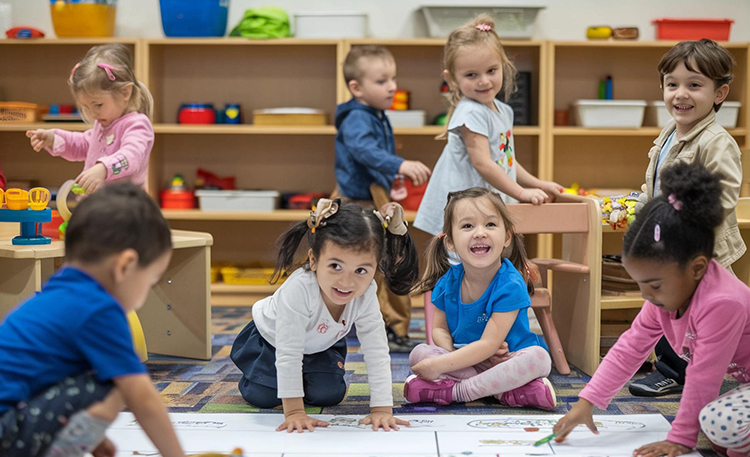
We build homes on strong foundations, so they stand steady for years, right! Children need the same kind of beginning. Their pre-primary years quietly shape how they explore, speak, play, make friends, and step into learning with confidence.
If home is the first school, pre-primary is the next gentle step, where children learn how to learn, how to express themselves, and how to feel secure in a world beyond home.
How Pre-Primary Foundations Show Up in Everyday Life
You can often see the early foundation not in tests or notebooks, but in small, everyday behaviours.
How they approach something new
A child who had a rich early experience usually tries, even when unsure. One who didn’t may hesitate or say “I can’t” very quickly.
How they interact with others
Sharing toys, waiting for turns, and speaking to peers are habits shaped long before primary students enter Class 1.
How they respond to stories and language
Children exposed to rhymes, conversations, and storybooks often enjoy reading and understand instructions better in later years.
How they handle simple structure
Cleaning up after play, following a short routine, or doing a small task independently all reflect the habits built during pre-primary years.
These little signs tell you how ready a child is for the more structured learning that comes next.
What Children Miss When Pre-Primary Years Aren’t Strong
When the foundation is rushed or too rigid, primary students may face difficulties that seem “sudden” but actually began earlier.
Struggles with attention
If play-based exploration was limited, focusing even for 5–10 minutes becomes tough.
Fear of mild challenges
When early experiences did not encourage trying, failing, and trying again, new tasks feel threatening.
Weak language base
Limited conversation or story exposure often leads to slow reading, unclear expression, or difficulty understanding instructions.
Poor motor skills
If children didn’t build fine motor strength in early years, writing can feel tiring or stressful in primary school.
These are not problems with intelligence, they are simply missing early habits that should have been nurtured gently.
Not Only School: What You as Parents Can Do During Pre-Primary Years
Even small home routines can strengthen what a child learns in school.
Keep routines simple and predictable: Children feel safe when mornings, meals, and sleep have a gentle pattern.
Offer lots of open-ended play: Blocks, pretend scenarios, puzzles, clay—these build imagination, problem-solving, and motor control far more than worksheets.
Read together every day: Even 10 minutes of stories improves vocabulary, listening, bonding, and emotional stability.
Encourage small acts of independence: Putting away toys, choosing a book, helping with tiny tasks—all build confidence.
Talk with your child often: Simple conversations are powerful for language growth and emotional security.
Parents don’t need to “teach” in a formal way. They only need to create simple, warm, and meaningful experiences every day.
Choosing the Right School in Pre-Primary Years
Just as the pre-primary years matter, the school chosen for these years matters just as much. The right pre-primary school doesn’t just keep your child safe it actually shapes how they will learn and enjoy learning for years to come.
At Gitanjali International School DLF, we treat pre-primary as a precious stage, not a preparation class. The environment is built around warmth, exploration, and gentle guidance:
- Classrooms have learning corners for reading, pretend play, puzzles, and art.
- Activities combine movement, language, and hands-on tasks, helping concepts make sense naturally.
- Teachers encourage independence through simple routines children can manage confidently.
- Children enjoy stories, rhymes, and early number experiences in a calm, playful setting.
By the time they become primary students, they already carry habits of focus, curiosity, early number sense, and the confidence to try new tasks.
This early base makes the transition to structured learning smooth and joyful.
Final Words
Pre-primary years may look simple, but they quietly hold some of the most important work of childhood. These early experiences shape confidence, curiosity, communication, and the ability to enjoy learning not just in Class 1, but all the way through school.
When we nurture a strong beginning at home and through the right early-years of school, we give children a foundation that supports every step that follows. A home stands tall when its base is strong. A child’s learning does too.
phjili58com
August 25, 2026Finally found a platform that actually pays out on time. The interface is super intuitive and easy to navigate. Great experience so far with phjili58com!
bajiloginpakistanapp
August 27, 2026Finally a platform that actually works smoothly in my region. The login process is seamless and the app performance is top notch. bajiloginpakistanapp is definitely the way to go.
ph500jili
August 29, 2026The best place for Jili fans in the Philippines. Everything is localized and the deposit methods are very convenient for us. ph500jili