


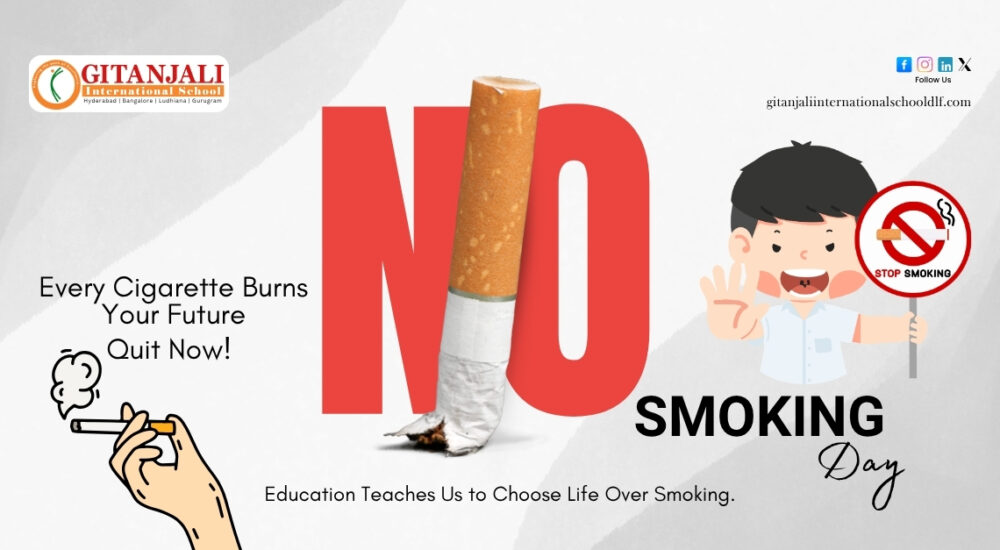
No Smoking Day serves as a global awareness event which takes place every year to promote healthier living while minimizing tobacco-related health risks. The public considers smoking to be an adult problem yet individuals start to develop their smoking habits during their formative years when they learn to make decisions and form their attitudes. Schools play a meaningful role in shaping these early understandings which help students learn about health and responsibility and make positive choices.
At Gitanjali International School DLF Phase 4 Gurugram health awareness functions as a vital life skill which students study throughout their education. The process of developing healthy habits begins for children through learning activities which match their current developmental stage.
Understanding the Real-World Impact of Smoking
The impact of smoking on the health of people around the world (WHO) and more than 8 million people die each year because of tobacco – and this includes the effects of exposure to secondhand smoke – is that smoking is one of the most significant global health problems (WHO). Children, especially young children, are more likely to experience negative effects due to their developing lungs, immune systems, and overall bodies from breathing in secondhand smoke or other types of air pollutants.
Connecting what they learn in the classroom to real-world examples of being healthy (or not healthy) will help children realize that being healthy is not just a “classroom lesson,” but rather a living, breathing (no pun intended) reality for people, families, communities, and the environment. When students learn about breathing, clean air, and environmental stewardship, they also discover how to connect what they have learned to many “real-life” experiences, such as:
- Understanding why clean air is important at home and in public
- Seeing how negative habits of individuals negatively affect both individuals and their communities
- Knowing that when they make healthy decisions at a young age, they can create a better future for themselves.
By creating this bridge between education and the real world will help to strengthen and promote responsible and thoughtful ways of living from an early age.
How Education Connects Health Awareness to Everyday Learning
Effective awareness goes beyond simple instruction. It becomes meaningful when integrated into everyday learning experiences. Health education is naturally connected with science, environmental studies, storytelling, and creative activities.
Young learners explore concepts through:
- Science-based learning that explains how lungs help the body breathe
- Story-based activities featuring characters who make healthy lifestyle choices
- Creative art sessions where students design posters promoting clean air
- Interactive classroom discussions that encourage curiosity about healthy habits
Such integrated learning ensures that awareness becomes part of daily thinking rather than a temporary lesson. Institutions recognized as the best preschool in Phase 4, Gurugram, Haryana often adopt this method to create strong foundations for lifelong health awareness.
Experiential Learning: Turning Awareness into Action
Through Experiential Learning, we are able to convert our Awareness into Action.
Experience is the best way for children to learn. When children see, explore and take part in their community they will have the ability to transfer their Awareness into Actions, which in turn allows them to keep the lesson in their memory for longer periods of time.
Some examples of experiential learning activities could be:
- Clean Air Awareness Activities – students learn the importance of observing and valuing their environment (in this instance, the air).
- Role-Playing – children will learn to develop healthy decision-making skills by acting out certain situations they may find themselves in.
- Nature Walks – students learn the importance of fresh air, trees and plants and how we should care for our environment.
- Poster and Creative Projects – students will have an opportunity to express their understanding through art.
These types of experiential learning activities increase student engagement and create a fun and memorable experience; therefore, demonstrating how knowledge and action are linked.
Student Leadership and the Growth of Responsibility
Children develop leadership skills through the process of sharing their ideas and taking charge of their actions. Through classroom discussions and health message sharing and awareness presentation participation, No Smoking Day awareness activities help students develop their confidence and teamwork abilities and communication skills.
The experiences at Gitanjali International School DLF Phase 4 Gurugram help students develop self-confidence and responsibility skills which enable them to become thoughtful decision-makers.
Long-Term Impact on Character and Future Readiness
Health awareness education teaches children about harmful habits because it shows them their destructive effects. The program develops three key abilities, which enable children to choose their activities wisely while maintaining their health. The program teaches students essential life skills, which help them develop discipline and confidence, while they build positive habits that will help them succeed academically and personally.
Life skills development enables children to achieve academic success while preparing them for responsible adult life, which allows them to become valuable community members who make wise choices throughout their lives. The designed activities develop particular abilities, which help children achieve their educational goals and develop their social skills.
Integrating Awareness into a Future-Focused Learning Environment
The current educational system trains students to face actual challenges which exist in the world. Health awareness programs such as No Smoking Day align with broader learning goals, including environmental care, emotional well-being, and social responsibility.
Academic programs which follow a defined structure help students develop useful skills that connect classroom learning to their daily life experiences. The top preschool in Phase 4 Gurugram Haryana schools provide education through integrated programs which help students develop both academic knowledge and essential life skills needed for future success.
Building a Health-Conscious Generation
People need education about health problems which should begin from their earliest life stages. Children who participate in fun activities and actual life situations learn about healthy living will create permanent health habits.
Gitanjali International School DLF Phase 4 Gurugram develops responsible students through experiential learning and character-building programs which help students learn healthy habits and make good decisions while growing into dedicated adults.
FAQ’s:
- How do preschools teach children about healthy habits?
Preschools use storytelling, role-play, and creative projects to teach healthy living. The best preschool in dlf Phase 4, Gurugram, Haryana integrates health awareness into daily learning. - Why is No Smoking Day awareness important in preschool?
No Smoking Day awareness helps children learn healthy habits early. The best preschool in Phase 4, Gurugram, Haryana introduces these concepts through simple and engaging activities. - What activities are conducted on No Smoking Day in preschool?
Common activities include poster-making, nature walks, and group discussions that promote clean air and healthy living at the best preschool in dlf Phase 4, Gurugram, Haryana.