


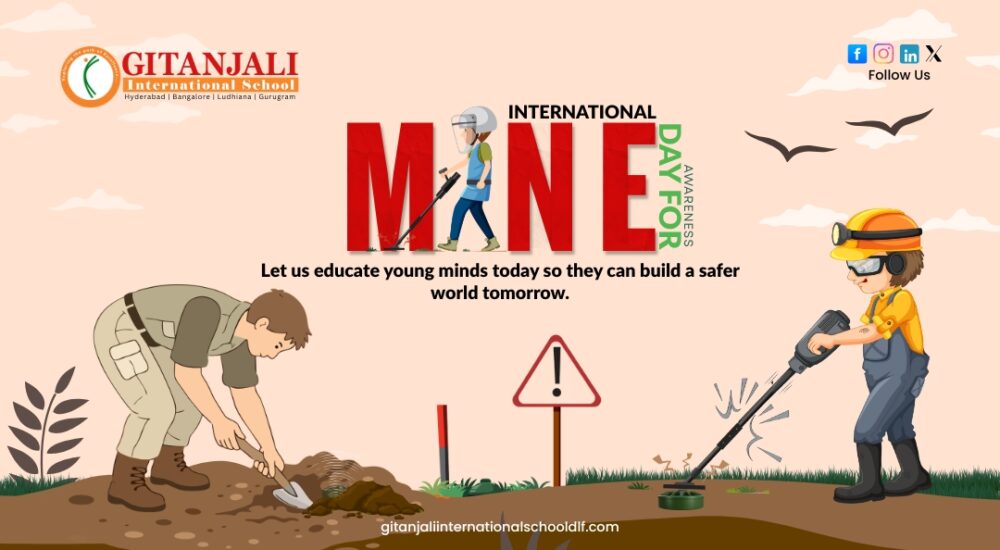
The world observes International Day for Mine Awareness and Assistance in Mine Action every year to educate people about the risks associated with landmines and unexploded ordnance which remain after wars. The topic may appear remote from daily school activities yet it provides students with essential knowledge about safety practices and ways to show kindness and their responsibility towards the world. Gitanjali International School DLF Phase 4 Gurgaon teaches students about real-world challenges through its learning program which extends beyond classroom materials to demonstrate how education creates safer communities.
Understanding the Meaning of the International Day for Mine Awareness
People frequently bury landmines and unexploded ordnance underground in former battlefields. The hazardous remnants from conflicts which ended years ago still pose threats to people, particularly children. The International Day for Mine Awareness helps people understand these risks and highlights the importance of creating safe environments worldwide.
Students start their learning process about safety and responsibility through basic safety information. Teachers use storytelling and visual materials to introduce the topic, which shows children how their minor actions like staying alert and following safety signs will protect them from accidents. The approach encourages students to explore their surroundings while developing empathy toward communities which face such difficulties.
How Education Connects to Real-World Issues
The fundamental value of education exists because it enables students to apply their classroom knowledge to actual life experiences. The International Day for Mine Awareness provides an opportunity for students to understand how geography, social studies, and technology relate to global safety.
Through guided lessons students learn how trained teams work together to locate and remove landmines safely. The team discovers how teamwork and technology and international cooperation function together as one unified system. The discussions raise awareness of the topic while they create interest in the scientific and innovative methods that scientists use to solve actual problems.
At institutions like Gitanjali International School, DLF Phase 4 Gurgaon, teachers emphasize that education is not limited to textbooks. The approach functions as a bridge which connects students from their current knowledge base to their future obligations according to the most respected CBSE preschools located in Phase 4 DLF Gurgaon.
How School Learning Programs Integrate This Awareness
Schools are essential tools for transforming awareness into an active and meaningful experience by creating exciting opportunities for students to learn about significant issues through practical, activity-based programs.
The following are some of the successful methods used by schools to incorporate mine-awareness into their curriculum:
- Creating posters/drawings that are related to the theme of peace and safety
- Using interactive story-telling as a way to explain the hidden dangers in a way that is simple to understand
- Delivering educational videos and presentations on global safety procedures
- Engaging in discussion with classmates on mine-awareness and allowing them to express themselves through questions and ideas.
All of these activities not only allow for creative expression but also help students reinforce their understanding of safety and responsibility. Structured programs such as these demonstrate how 21st Century educational systems support both academic growth and the development of awareness.
How Experiential Learning and Student Leadership Evolve
Experiential learning allows students to learn by doing rather than simply listening. When students actively participate in awareness activities, they develop confidence, teamwork skills, and leadership qualities.
For example, students may create safety-themed posters, participate in role-play activities, or share short messages during school assemblies. Older students often take leadership roles by guiding group discussions or presenting safety information to their peers.
These experiences help students understand the value of collaboration and communication. Over time, they begin to recognize that leadership is not about authority but about responsibility and the willingness to help others.
Safety Awareness; Safety Awareness in Our Daily Lives
The importance of safety habits learned on the International Day for Mine Awareness applies to day-to-day living in a very real way. When students are taught to look for and recognize warning symbols, as well as follow directions and remain alert in new environments, they are also learning about developing a habit of safety in their daily lives.
Teachers can assist students to build on these lessons by encouraging them to:
- Pay attention to and follow safety signs and guidelines.
- Use caution when in an unfamiliar area.
- Ask for help from an adult if they are unsure of something.
- Share their safety awareness and education with friends and relatives.
These simple safety practices help students to develop a responsibility and awareness for their safety both in and out of the classroom.
Long-Term Impact on Character and Preparedness for the Future
In addition to providing awareness-based knowledge, awareness programs influence the development of individual traits. The experience of learning about Global Challenges fosters the characteristics of empathy, patience, and social responsibility.
This type of learning experience not only assists in the development of character traits but also builds foundational skills necessary for success within one’s lifetime. Some examples of these skills include:
- Critical thinking skills – By analyzing live global events students develop critical thinking skills.
- communication skills are achieved through giving presentations and participating in group discussions.
- Leadership skills develop through involvement in various awareness programs.
- Global awareness students develop an understanding of their role within a global society through their exposure to awareness programs.
At Gitanjali International School in DLF Phase 4, Gurgaon, awareness programs support students in their development as a whole person. Schools within the CBSE and preschools Phase 4 DLF Gurgaon support learners to become successful academically and socially responsible.
Building Responsible and Compassionate Citizens
The International Day for Mine Awareness demonstrates how education functions as a tool for building safer communities. The school system teaches students about global issues through age-appropriate methods which show them the value of peace and cooperation and responsibility.
Students develop into self-assured and compassionate people through initial safety and awareness instruction. Schools develop responsible citizens through their interactive programs which include leadership development to create a safer and more compassionate society.
FAQ’s:
- What role do schools play in spreading mine awareness?
Schools educate students through structured programs that connect classroom learning to real-world safety issues. - How does experiential learning support mine awareness education?
Experiential learning helps students understand safety concepts through activities, role-play, and group discussions. - How does mine awareness help in character development?
Mine awareness teaches responsibility, compassion, and teamwork, shaping students into responsible citizens. - Why is global safety education important in early learning?
Global safety education helps students develop awareness, empathy, and readiness to handle real-life situations.
megawin777slot
September 18, 2026Hit a massive jackpot last night! The excitement is unreal on this site. You should definitely try your luck at megawin777slot.